
Case study · Mobility · Client name withheld under confidentiality
Rideshare app development for an Australian rideshare platform
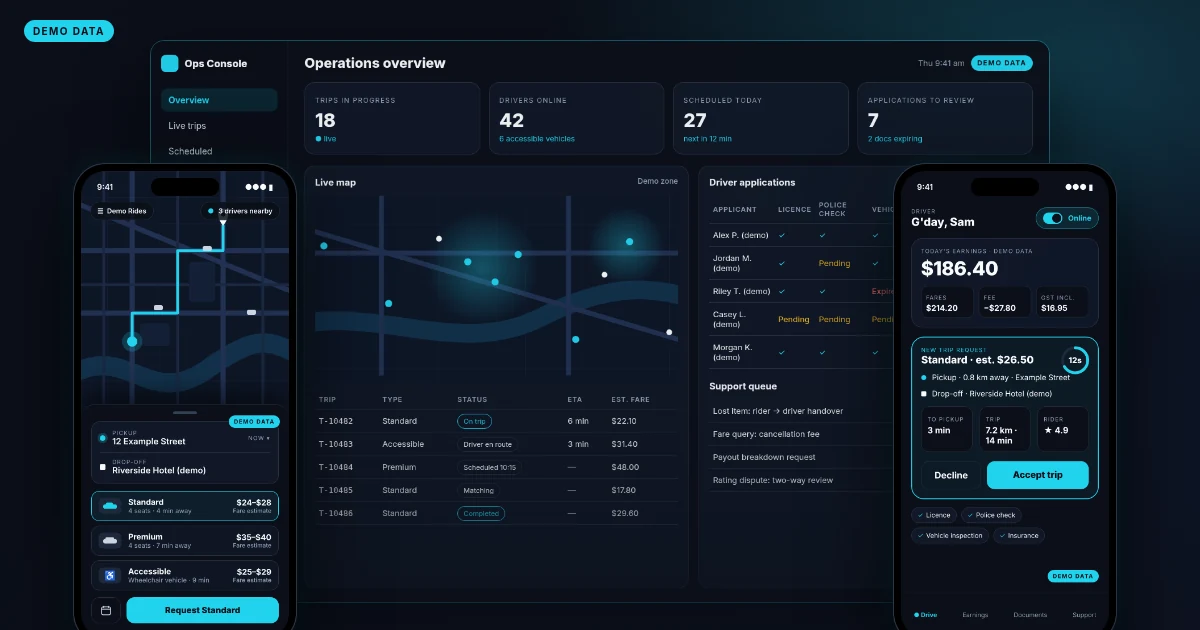
Aideveloper built a complete rideshare product for an Australian operator: a rider app and a driver app for iOS and Android, an operations console, and the backend services that connect bookings, drivers, payments and support.
- Real client project
- Client name withheld under confidentiality
- Screens shown are Aideveloper demo mock-ups
The challenge
Competing on trust, not just on price
Ride-hailing in Australia is dominated by global apps with big engineering teams. Our client wanted to launch a local rideshare service that won riders on safety, choice and service, and won drivers on clear, fair earnings.
To do that, a small operator needed the same polished experience riders expect from the major apps, plus the back-office tools to screen drivers properly and support people at any hour, without hiring a large operations team.
- Two audiences, two apps. Riders and drivers need very different journeys, permissions and notifications.
- Trust and safety from day one. Driver screening, live tracking, two-way ratings and emergency options can't wait for version two.
- Money handled cleanly. Payment at the end of the trip, cancellation rules, and driver earnings that show fees and tax openly.
- Operable by a lean team. Driver applications, trips and support handled in one place.
What we built
Rider app, driver app, ops console and the services behind them
Three connected applications on one shared platform. Every rider and driver feature listed below is in the live apps.
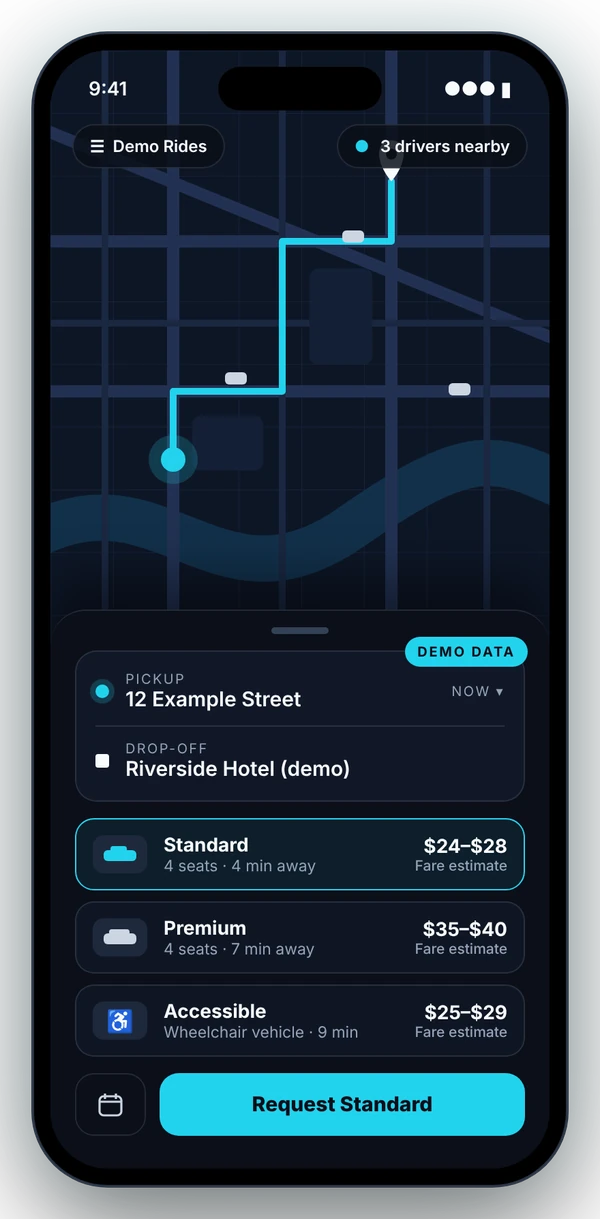
Rider app (iOS and Android)
- Account sign-up with a payment card added and verified before the first trip
- Pickup and drop-off entry, with a choice of vehicle type, including standard, premium and wheelchair-accessible options
- Book now, or schedule a ride ahead by date, time and pickup point
- Automatic matching to a nearby available driver
- Real-time GPS tracking of the driver and the trip
- Card, mobile-wallet and in-app payment, charged automatically when the trip ends
- Cancellation rules with a free window and a fee for late or repeated cancellations
- Two-way ratings, so riders rate drivers and drivers rate riders
- Safety tools to share trip status and location with a trusted contact and call emergency services from the app
- Access to 24/7 help, including lost-property follow-up through support
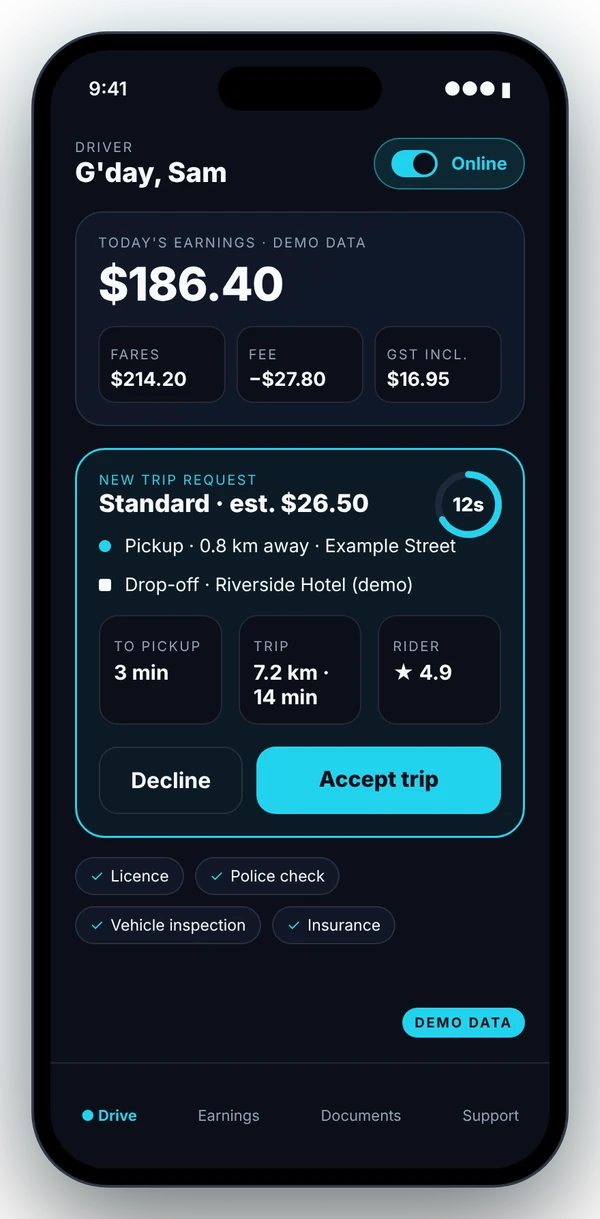
Driver app (iOS and Android)
- Guided onboarding: create an account, accept the driver agreement and terms, enter details and upload documents
- Submit for review, with a notification when the application is approved
- Screening that supports police background checks, driving-history verification, vehicle inspection and insurance evidence
- Trip requests from riders, with live GPS during the trip
- Transparent earnings that show fares, platform fees and the tax component, with nothing hidden
- Monthly earnings reporting, including peak times and locations, so drivers can plan their week
- Emergency features and 24/7 driver support
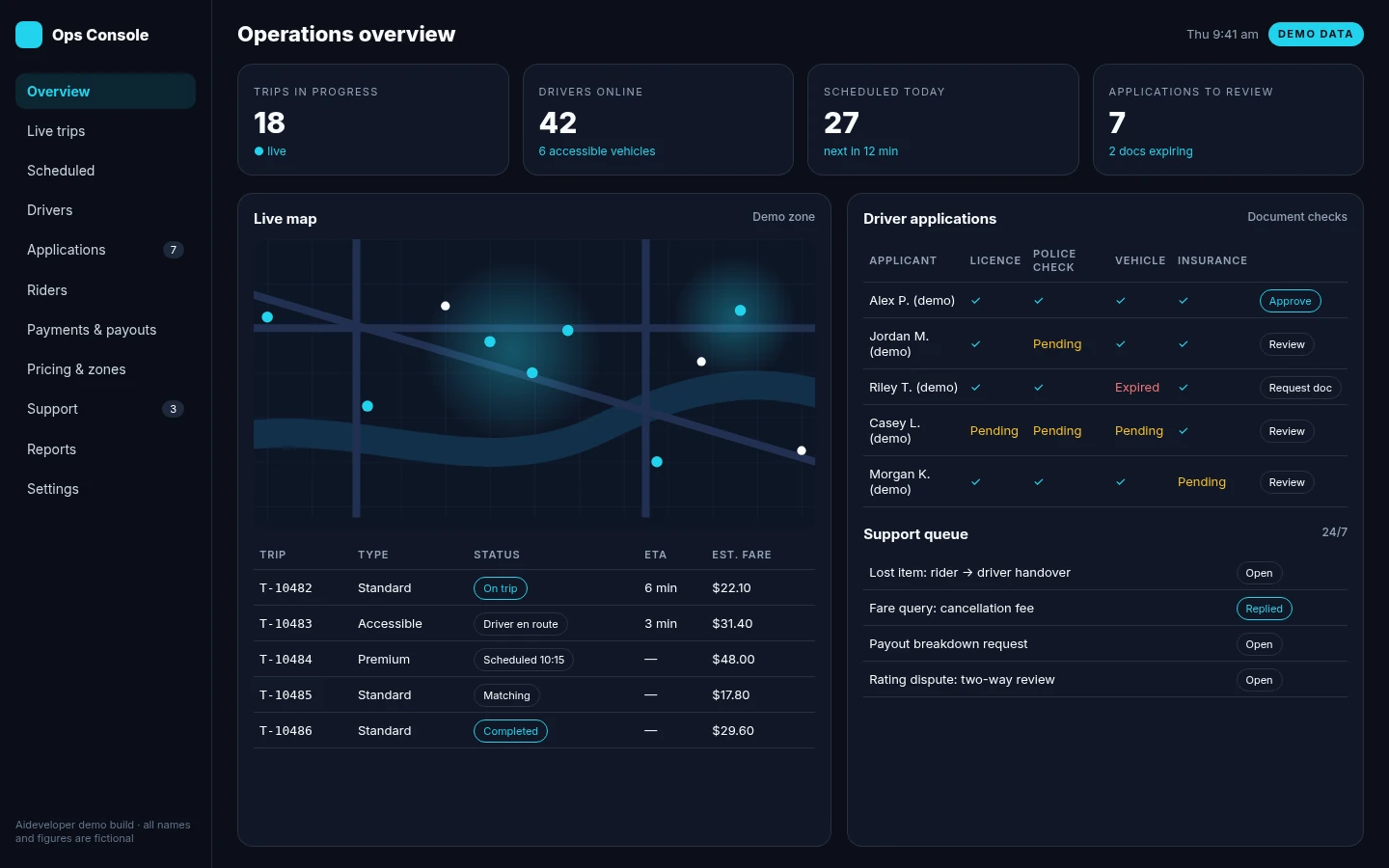
Operations console
The web back office the operator's team works from:
- Reviewing driver applications and uploaded documents, then approving drivers
- Oversight of riders, drivers and trips
- Support follow-up for fare queries, lost property and safety concerns
- Driver earnings data behind the monthly reports
Platform services
The shared backend both apps and the console run on:
- Matching and dispatch: finds and assigns a nearby available driver, including for scheduled rides
- Pricing and fees: fares by vehicle type, plus cancellation fees and platform fees
- Payments: stored payment methods, automatic charge at trip end and driver earnings records
- Location and notifications: live trip tracking, trip status updates, and approval and support notifications
Built for Australia
Australian requirements a rideshare platform has to handle
An imported "Uber-like" template rarely covers Australian rules out of the box. These are the areas we design for on any Australian rideshare or point-to-point transport app.
Driver accreditation and checks
Rideshare is regulated state by state. Driver authorisation, vehicle standards, safety duties and booking records differ between jurisdictions. The onboarding flow, the documents collected and the human review step need to fit the states you operate in, with expiries tracked so lapsed documents are caught.
GST and tax reporting
The ATO requires rideshare drivers to register for GST from their first fare, whatever their turnover. Drivers need clear records of fares, fees and GST. Under the ATO's sharing economy reporting regime, platforms also report ride-sourcing transactions. Some states add per-trip levies, so pricing has to make room for jurisdiction-specific charges.
Payments
Card details should never touch your servers. A PCI DSS-compliant payment provider tokenises cards and wallets, the trip amount is confirmed when the ride ends, and the cancellation and refund rules shown to riders have to match what the system actually charges.
Privacy and location data
Live location, trip history and ID documents are sensitive personal information under the Australian Privacy Principles. Collect only what's needed, restrict who can see documents, and set retention periods. From 10 December 2026, automated decisions about people, such as pricing or driver deactivation, also need to be explained in your privacy policy. See our guide to the automated decision-making Privacy Act changes.
Accessibility
Wheelchair-accessible vehicles have to be bookable as their own vehicle type, not left to luck. The apps themselves should work with screen readers, larger text and good contrast, in line with WCAG 2.2 and the intent of the Disability Discrimination Act.
Safety and incident handling
The apps provide trip sharing, emergency calling, two-way ratings and 24/7 support. Behind them, the operator needs a clear record of what happened on a trip when something goes wrong, plus moderation and behaviour rules that riders and drivers agree to on sign-up.
This is general information, not legal or tax advice. Check current state transport and ATO requirements for your model.
Tech approach
How a rideshare platform like this is put together
Below is a typical architecture for this kind of product. The client's exact stack, vendors and infrastructure are confidential.
iOS and Android apps with a maps SDK, foreground and background location, push notifications and secure sign-in.
A persistent connection streams driver location and trip status (requested, matched, arriving, on trip, completed or cancelled) to both apps.
A geospatial index of available drivers by vehicle type, with request offers, timeouts and re-offers if a driver declines.
Booked-ahead rides stored as future jobs and released to matching early enough to reach the pickup on time.
Fare rules by vehicle type, plus cancellation and platform fees, using a tokenised payment provider and an earnings ledger for each driver.
A web admin with role-based access, document storage with restricted access, audit logs and reporting.
Want to compare off-the-shelf rideshare software with a custom build? Our AI software development and AI integrations teams can scope both options honestly.
Delivery process
How we deliver rideshare and on-demand apps
Our usual delivery stages for a three-sided mobile product. Each phase ends with something you can test.
- Discovery and rulesMap the service types, fares, cancellation policy, driver requirements and the state rules that apply, before any screens are designed.
- Journeys and designDesign the rider, driver and operator journeys side by side, so each trip state looks right on all three screens.
- Core loop firstBuild request, match, track, pay and rate end to end, then add scheduling, safety tools and reporting on top.
- Field testingTest on real devices on real streets, including GPS drift, patchy coverage, backgrounded apps and payment failures.
- Store releasePrepare App Store and Google Play submissions, covering location permission wording, account deletion and review notes.
- Launch and improveSupport the launch, watch the support queue, and keep shipping improvements to both apps.
More detail: our delivery stages and AI development process.
Where AI fits
How AI can extend a rideshare platform
These are capabilities we can add to a platform like this. They are next steps, not part of the delivered scope described above.
ETA prediction
Learn from completed trips to predict pickup and arrival times more accurately than routing estimates alone, by time of day and area.
Demand forecasting
Turn peak-time and location history into forward-looking demand forecasts, so drivers know where and when to be online and scheduled rides are covered.
Fraud and abuse detection
Flag payment fraud, GPS spoofing, duplicate accounts and promo abuse for a person to review, instead of blocking people automatically.
Support automation
An AI support assistant that answers fare and lost-property questions around the clock and hands safety issues straight to a human. AI agents can draft follow-ups for the team.
Document checks with computer vision
Computer vision and document AI can read licence and registration details and expiry dates from uploads, then route anything unclear to a person for review.
Ops automation and routing
Workflow automation for expiry reminders and payout reports, and transport AI for smarter routing and positioning.
FAQ
Rideshare app development: common questions
How much does rideshare app development cost in Australia?
How long does it take to build a rideshare app?
Should we use an Uber clone script or build a custom rideshare app?
Do riders and drivers need separate apps?
What Australian rules affect a rideshare platform?
Can AI be added to an existing rideshare app?
Why isn't the client named?
Planning a rideshare, booking or on-demand app?
Tell us about your service, your drivers or providers, and where you want to launch. We'll map out a practical first release, and show you where AI can save your team time later.
Talk to AideveloperBook an AI business audit