
Case study · Active travel · IoT · Pilot program
RideScore Active Schools: an active school travel app pilot, delivered end to end
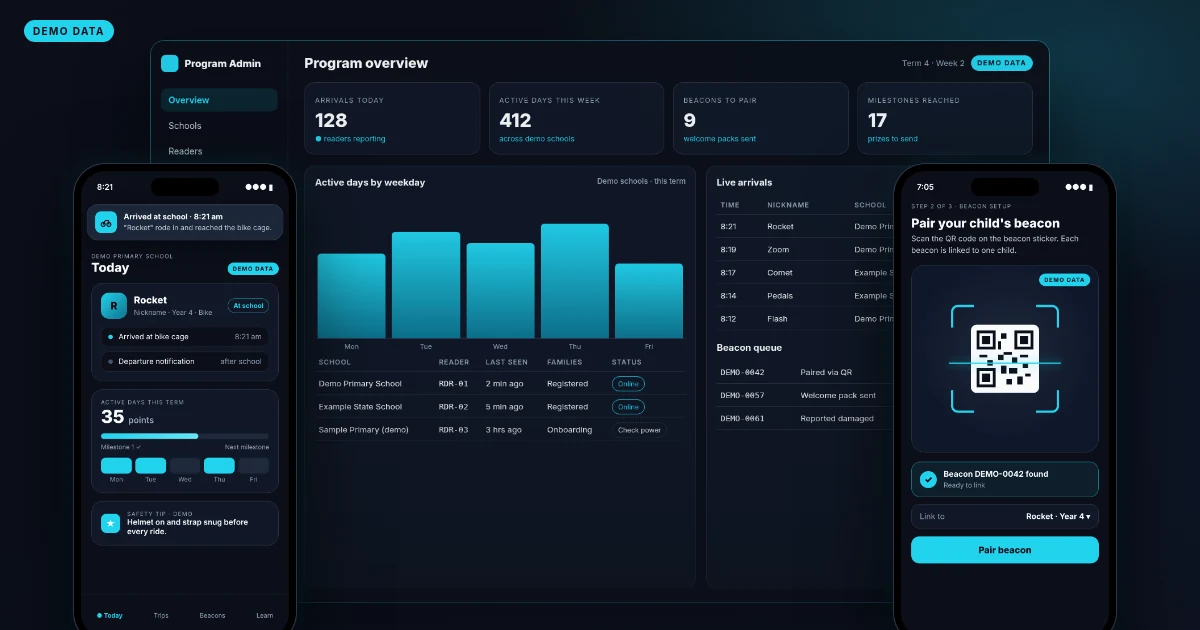
RideScore is a pilot program that rewards children for riding and scooting to school. A Bluetooth beacon on each bike or scooter is detected by a reader at the school bike cage, and the parent or carer gets an instant arrival or departure notification. Smarterapps Ai, part of the Aideveloper group, built and installed the pilot end to end.
- Pilot program (in trial)
- Delivered by Smarterapps Ai, part of the Aideveloper group
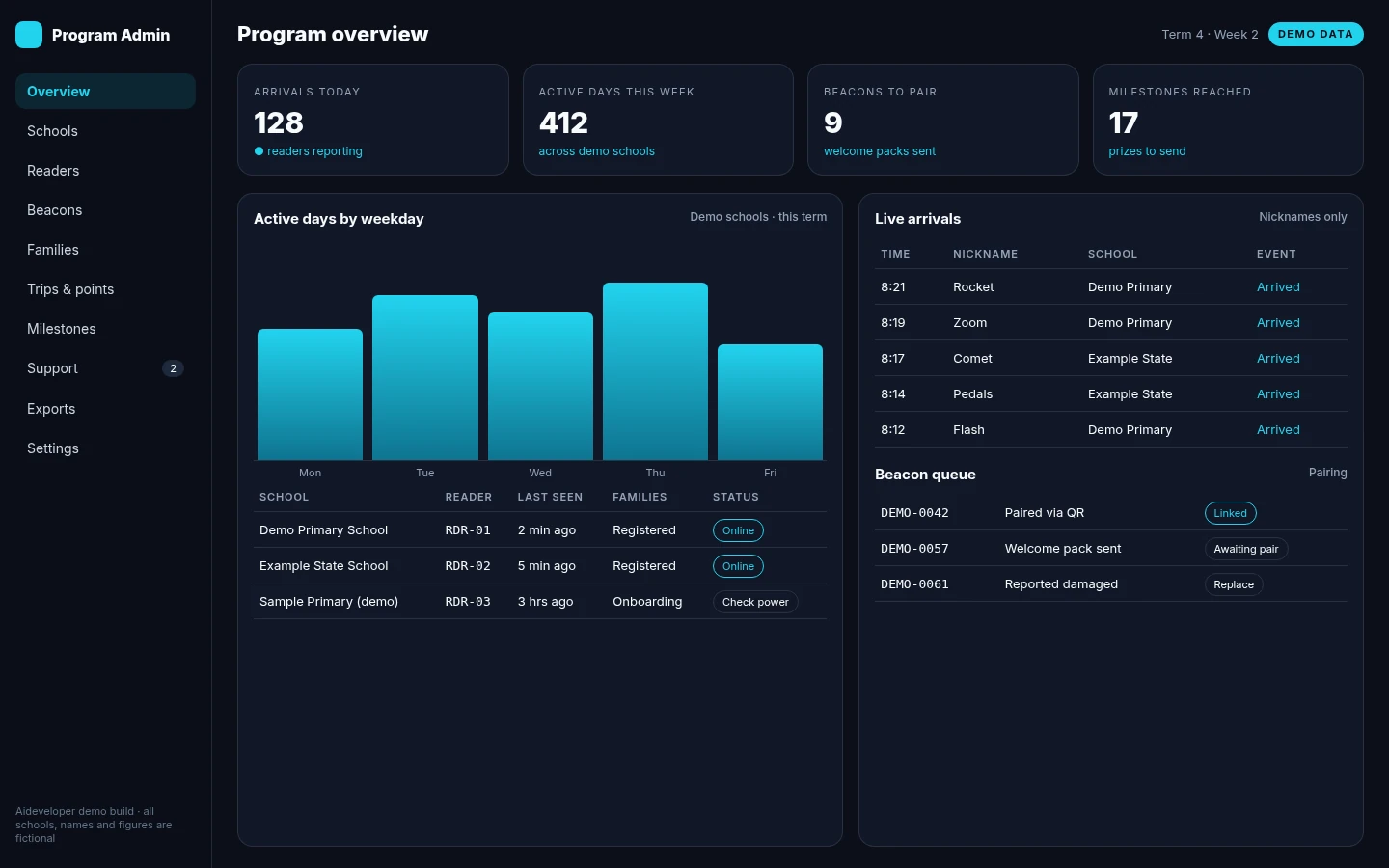
- Screens shown are Aideveloper demo mock-ups
The program
Giving parents the confidence to let kids ride to school
Fewer Australian children ride or scoot to school than in past generations, and the school run adds to peak-hour congestion around school zones. A major barrier for parents is safety: they want to know their child arrived.
RideScore answers that with a simple promise. When a child rides into the school bike cage, the parent or carer is told straight away, and again when the child leaves. Every active day earns points, milestones earn rewards, and friendly characters teach bike education and road safety.
The pilot's original stakeholders were federal government stakeholders, We Ride Australia and Sunshine Coast Council. RideScore's background includes a Sunshine Coast Council proof of concept at Caloundra State School, for which the council received a national Cycling Luminaries Award.
- Peace of mind for parents. Arrival and departure notifications, sent automatically from the school.
- Motivation for kids. A point for every active day, with rewards at milestones.
- No tracking of children. Beacons are only detected at the school reader, never along the route.
- Built to scale. The program aims for a framework that more schools and states can adopt.
What we delivered
Apps, platform, hardware and installation, all from one team
Smarterapps Ai, our sister brand within the Aideveloper / Combine TRS group, delivered the RideScore pilot end to end. That covered the mobile apps, the admin portal, the backend and data platform, the beacon and reader integration, sourcing the beacons and readers, and installing the hardware at every pilot location.
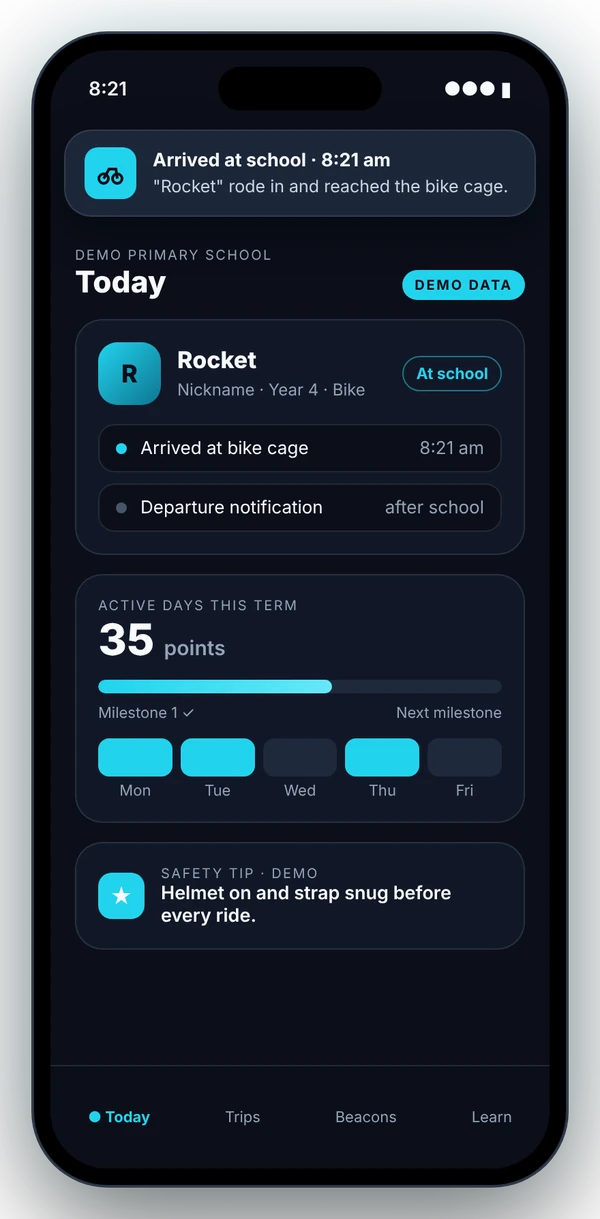
Parent app for iOS and Android
- Email sign-up, with email verification on every device for security
- One family account that can be used on several devices, all of which receive notifications
- Child profiles with class details, a few questions about current travel habits, and a nickname, so real names never appear on public lists
- Instant push notifications when a child arrives at or leaves the school bike cage
- A trips view showing active days, points and progress towards milestones
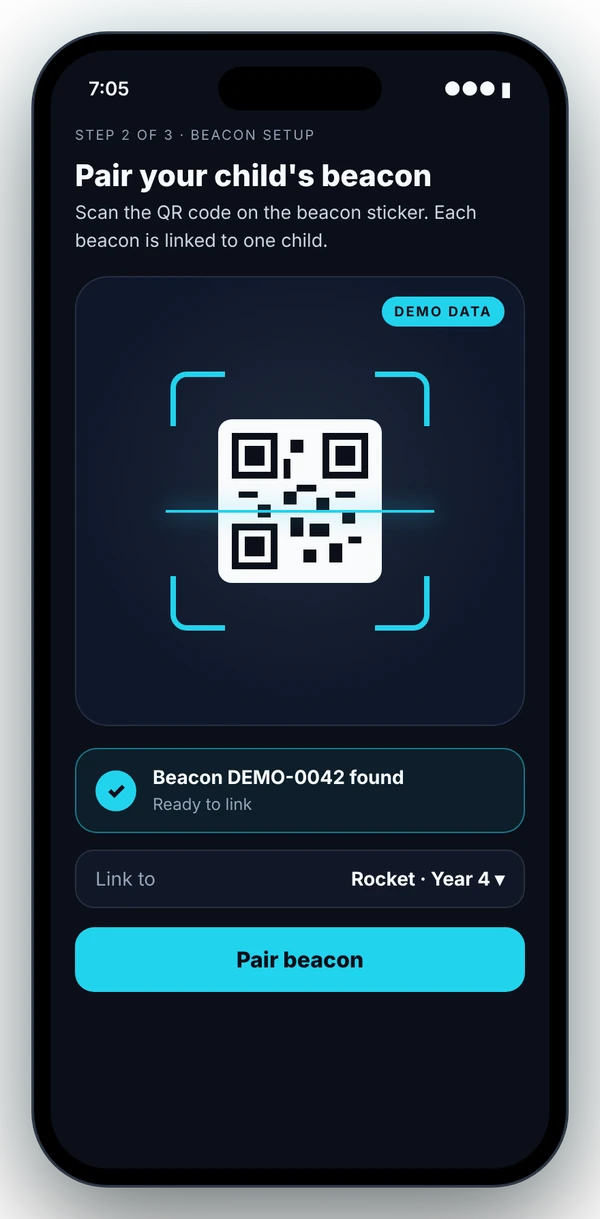
Beacon pairing by QR code
- Each child receives a weatherproof Bluetooth beacon that zip-ties to the bike frame or scooter stem
- Parents pair it in the app by scanning the QR code on the beacon sticker with the phone camera
- One beacon per child, linked to that child's profile, so detections are credited to the right child
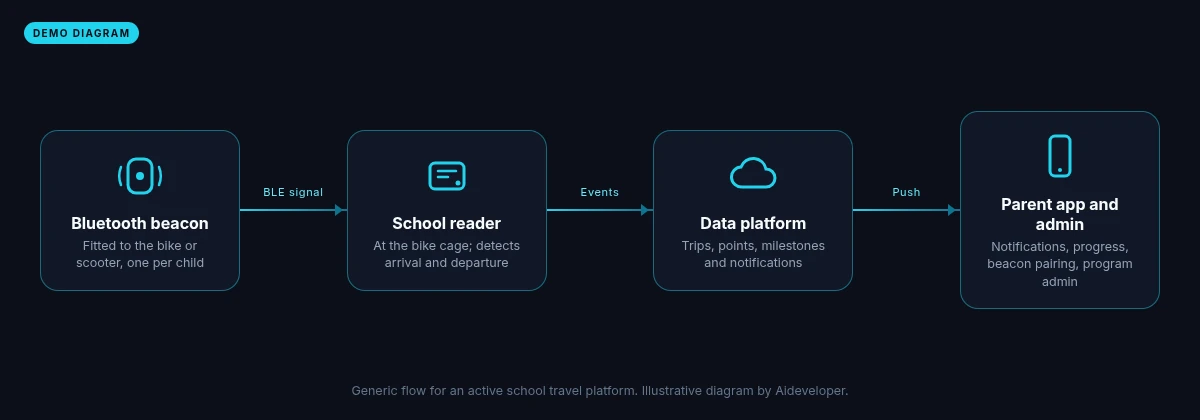
Beacon and reader integration
- Readers at each school bike cage run software that listens for registered beacons
- A beacon coming into range records an arrival, and a beacon that is no longer detected records a departure
- Each event goes to the platform, which sends the push notification to the nominated parent or carer
Backend and data platform
- Records every trip from reader events
- Awards one point per active day and tracks milestones for rewards
- Manages families, children, beacons and schools, and sends notifications
Admin portal
- A secure admin login for program staff
- Oversight of participating schools, readers, beacon allocation and pairing
- Participation, trips and milestone tracking for rewards and reporting
Hardware sourcing and installation
- Sourced the Bluetooth beacons and the school readers
- Installed the readers at all pilot locations, at the bike cages where students store their bikes and scooters
- Set up the hardware so detections flow through to the platform
Children's privacy
Privacy by design for children's data
Any app that handles information about children has to clear a higher bar. These principles shaped the platform.
Detection, not tracking
Beacons are only "seen" by the reader at the school. The system records an arrival and a departure, not a child's route or location around town.
Nicknames on anything public
Children take part under a nickname that's unique within their school, so their real names don't appear on public lists. Inappropriate nicknames can be rejected.
Parent-controlled accounts
Parents or carers register, verify their email on each device, and pair the beacon themselves. Notifications only go to devices signed in to that verified account.
Collect only what's needed
Data is limited to what the program needs: the family account, the child's profile and class, the beacon link, and trip events. It is handled under the Australian Privacy Principles, with restricted admin access.
We describe design principles here, not certifications. Privacy obligations depend on the program operator and the jurisdiction.
Tech approach
How an active school travel platform fits together
The architecture behind a beacon program like this one, described at a general level.
Low-power BLE transmitters, one per child, each linked to a profile by a QR code at pairing time.
Bluetooth-equipped readers at the bike cage that detect registered beacons and report arrival and departure events over the network.
Turns raw detections into clean trip events, so a child lingering near the cage doesn't trigger repeat notifications.
Push notifications to every verified device on the family account, sent as soon as an event is confirmed.
Rules that award one point per active day and flag milestone rewards for program staff.
A web portal with role-based access for program staff, plus reporting that supports scaling to more schools.
Planning something similar? See our hardware and edge devices, integrations and software development services, or Smarterapps Ai for iOS and Android app development.
Delivery
How the pilot was delivered
One team covered the software, the hardware and the time on site, so there were no hand-offs between an app vendor, a hardware supplier and an installer.
- Program design with stakeholdersTurned the program's goals, reward rules and privacy needs into a parent journey and a set of platform requirements.
- Hardware selectionSourced beacons that suit a bike or scooter, and readers that work at a school bike cage.
- Apps and platformBuilt the iOS and Android apps, the backend and data platform, and the admin portal.
- Beacon and reader integrationConnected reader detections to trip events, points and push notifications.
- Installation at schoolsInstalled and commissioned the readers at every pilot location.
- Ready for trialHanded over a working pilot, with the apps live on the App Store and Google Play and ready for families to register.
Where AI fits
How AI could extend an active travel program
These are possible next steps, not part of the pilot scope described above.
Participation insights
Spot which schools, year levels and weekdays are growing or slipping, so program staff can target encouragement and events.
Device health monitoring
Flag readers that have gone quiet, or beacons that are rarely detected, before families notice missing notifications.
Parent support assistant
An AI assistant that answers pairing and notification questions at any hour and hands anything unusual to a person.
Privacy-safe bike rack counts
Computer vision can count bikes and scooters in a rack without identifying anyone, giving whole-school active travel numbers alongside beacon data.
More on AI in schools: education AI. Transport and congestion: transport AI.
FAQ
Active school travel app: common questions
What is an active school travel app?
Does a beacon program track children?
Who built RideScore?
What does a Bluetooth beacon app development project involve?
Can a program like this scale to more schools?
How is children's data protected?
Planning a beacon, IoT or community program app?
Tell us what you want to measure, who needs to be notified, and where the hardware has to live. We'll help you plan a pilot that covers the apps, the platform and the installation in one go.
Talk to AideveloperVisit Smarterapps AiRideScore case study delivered by Smarterapps Ai, part of the Aideveloper / Combine TRS group.